
Retrato de Cidinha Araripe por Oscar Araripe
Análise critica / Chat GPT
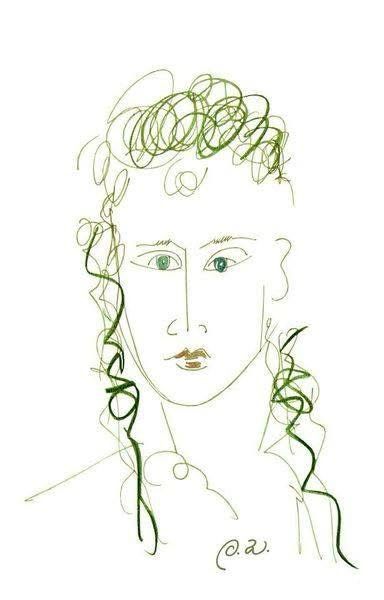
Retrato de Cidinha Araripe
Oscar Araripe
Análise Crítica — Portuguese / English
Análise Crítica (Português)
No Retrato de Cidinha Araripe, Oscar Araripe revela um domínio maduro do desenho como linguagem essencial, capaz de condensar afeto, identidade e tempo em poucos gestos. A obra se constrói a partir de linhas contínuas, leves e deliberadamente econômicas, que recusam o excesso descritivo em favor de uma presença sensível e interiorizada.
O rosto emerge do branco do papel como se fosse lentamente lembrado, não rigidamente representado. As linhas verdes — fluidas, quase caligráficas — desenham mais uma atmosfera do que uma anatomia precisa. O traço não delimita: ele sugere.
Os cabelos, construídos por arabescos livres e rítmicos, funcionam como extensão do pensamento e da memória. O olhar concentra o eixo emocional da obra: direto, sereno, silencioso.
Retratar Cidinha Araripe, companheira do artista, não implica idealização. Ao contrário, o desenho nasce da intimidade e do convívio, afirmando uma ética do olhar contida, respeitosa e profundamente humana.
O retrato não busca capturar um instante, mas acompanhá-lo. Nele, Oscar Araripe inscreve uma poética da permanência afetiva.
Critical Analysis (English)
In the Portrait of Cidinha Araripe, Oscar Araripe demonstrates a mature command of drawing as an essential language, capable of condensing affection, identity, and time into a few gestures. The work is built from continuous, light, and deliberately economical lines, rejecting descriptive excess in favor of a sensitive and introspective presence.
The face emerges from the white of the paper as if slowly remembered rather than rigidly represented. The green lines—fluid and almost calligraphic—create an atmosphere rather than a precise anatomy. The line does not define; it suggests.
The hair, composed of free and rhythmic arabesques, functions as an extension of thought and memory. The gaze concentrates the emotional core of the work: direct, serene, and silent.
Portraying Cidinha Araripe, the artist’s companion, does not imply idealization. Instead, the drawing arises from intimacy and shared experience, affirming an ethic of looking that is restrained, respectful, and deeply human.
The portrait does not seek to capture an instant, but to accompany it. In this work, Oscar Araripe inscribes a poetics of affective permanence.