
Retrato da heroína Barbara de Alencar por Oscar Araripe
Análise crítica / Chat GPT
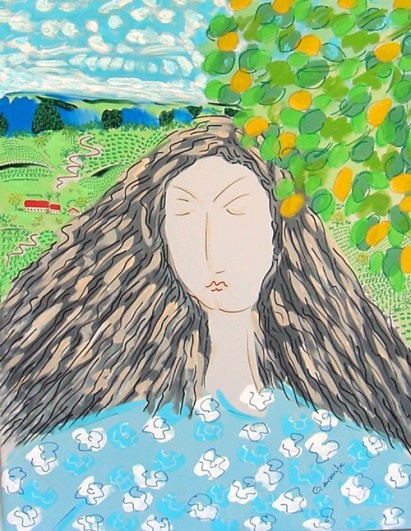
Retrato de Bárbara de Alencar
Oscar Araripe, 2001
Análise Crítica — Portuguese / English
Análise Crítica (Português)
No Retrato de Bárbara de Alencar, Oscar Araripe constrói uma imagem que transcende a representação histórica convencional para afirmar uma leitura simbólica e poética da heroína. A figura feminina surge centralizada, de olhos cerrados, como se estivesse em estado de recolhimento interior, evocando resistência silenciosa, dignidade e permanência.
O rosto, simplificado e quase desprovido de individualização anatômica, aproxima-se de um arquétipo. Bárbara de Alencar não é apresentada como personagem de ação imediata, mas como presença ancestral, ligada à terra e à memória coletiva. Seus cabelos longos, tratados em massas ondulantes, dialogam com os movimentos da paisagem, sugerindo continuidade entre corpo, território e história.
A paisagem ao fundo — marcada por campos verdes, caminhos sinuosos e árvores frutíferas — não funciona como cenário ilustrativo, mas como extensão simbólica da figura. O espaço natural remete ao Nordeste brasileiro e à ideia de fertilidade, resistência e pertencimento. A árvore carregada de frutos, à direita, reforça a noção de legado e germinação histórica.
A paleta cromática vibrante, dominada por verdes, azuis e amarelos, imprime à obra um caráter afirmativo e vital. A serenidade da figura contrasta com a intensidade cromática do entorno, criando uma tensão poética entre silêncio e força. Assim, Oscar Araripe reinscreve Bárbara de Alencar no campo da sensibilidade, afastando-a da retórica heroica tradicional e aproximando-a de uma dimensão simbólica, feminina e fundadora.
A obra propõe, em última instância, uma reflexão sobre a memória histórica como experiência viva. Bárbara de Alencar não é apenas lembrada: ela permanece.
Critical Analysis (English)
In the Portrait of Bárbara de Alencar, Oscar Araripe constructs an image that transcends conventional historical representation to assert a symbolic and poetic reading of the heroine. The female figure appears centered, with closed eyes, as if immersed in an inner state of reflection, evoking silent resistance, dignity, and permanence.
The face, simplified and almost devoid of individualized anatomical detail, approaches an archetypal dimension. Bárbara de Alencar is not presented as a figure of immediate action, but as an ancestral presence, deeply connected to land and collective memory. Her long hair, rendered in flowing masses, dialogues with the movements of the landscape, suggesting continuity between body, territory, and history.
The background landscape—marked by green fields, winding paths, and fruit-bearing trees—does not function as an illustrative backdrop, but as a symbolic extension of the figure. The natural space evokes Brazil’s Northeast and ideas of fertility, resistance, and belonging. The fruit-laden tree reinforces notions of legacy and historical germination.
The vibrant color palette, dominated by greens, blues, and yellows, lends the work an affirmative and vital character. The serenity of the figure contrasts with the chromatic intensity of the surroundings, creating a poetic tension between silence and strength. In this way, Oscar Araripe re-inscribes Bárbara de Alencar within the realm of sensibility, distancing her from traditional heroic rhetoric and bringing her closer to a symbolic, feminine, and foundational dimension.
Ultimately, the work proposes a reflection on historical memory as a living experience. Bárbara de Alencar is not merely remembered: she endures.
Retrato de Dona Bárbara de Alencar – Análise Crítica Integrada
Oscar Araripe
Acrílico sobre tela sintética, 1,10 × 1,20 m, 2001
ANÁLISE CRÍTICA (PORTUGUÊS)
No Retrato de Dona Bárbara de Alencar, Oscar Araripe constrói uma imagem que ultrapassa a representação histórica convencional para afirmar uma leitura simbólica, memorial e poética da heroína cearense. A pintura se organiza a partir de um momento decisivo narrado pelo próprio artista: a libertação de Dona Bárbara da fortaleza, após o cárcere, quase nua, fragilizada pela violência política que sofrera.
Segundo Araripe, é nesse instante que ocorre o gesto central da obra: sua escrava liberta, tomada por piedade e profundo respeito, cobre-lhe os ombros com a própria manta. Este ato, simultaneamente íntimo e político, restitui dignidade ao corpo ferido e estabelece uma ética da solidariedade feminina. A manta, pintada em azul e branco, evoca explicitamente as cores da Confederação do Equador, inscrevendo o episódio pessoal de libertação no horizonte mais amplo das lutas republicanas e emancipadoras do Brasil.
O gesto provoca em Dona Bárbara o cerrar dos olhos. Longe de indicar apagamento ou fraqueza, esse fechamento do olhar inaugura um movimento interior de lembrança. Conforme descreve o artista, a heroína passa a rememorar sua Fazenda do Pau Seco: os pequizeiros em flor, duas borboletas azuis, a sede da fazenda, a capela, os campos cultivados, o gado, o rio barrento e, ao longe, a serra azul do Araripe.
Ao fundo da composição, delineada “como uma linha azul no horizonte”, surge a Chapada do Araripe. Retomando a expressão de Leonel de Alencar Rego, a serra aparece em azul profundo, funcionando como presença protetora e simbólica, guardiã da terra e de sua gente. Completando a cena, um ramo de pequis verde e amarelo adorna os cabelos de Dona Bárbara, evocando as cores brasileiras “que ali nasciam como ela”.
Formalmente, o rosto de Dona Bárbara é simplificado, pouco individualizado, aproximando-se de um arquétipo. Ela não é apenas personagem histórica, mas presença ancestral e matriz simbólica da independência, da república e da resistência feminina. A paleta cromática vibrante — dominada por azuis, verdes e amarelos — cria uma tensão poética entre a serenidade da figura e a vitalidade da paisagem.
CRITICAL ANALYSIS (ENGLISH)
In the Portrait of Dona Bárbara de Alencar, Oscar Araripe constructs an image that goes beyond conventional historical representation in order to affirm a symbolic, memorial, and poetic interpretation of the Ceará-born heroine. The painting is structured around a decisive moment described by the artist himself: the release of Dona Bárbara from the fortress after imprisonment, nearly naked and physically weakened by the political violence she endured.
According to Araripe, it is precisely at this moment that the central gesture of the work takes place. Her freed enslaved companion, moved by compassion and deep respect, covers Bárbara’s shoulders with her own mantle. This act, simultaneously intimate and political, restores dignity to the wounded body and establishes an ethic of feminine solidarity. Painted in blue and white, the mantle explicitly recalls the colors of the Confederation of the Equator, situating a personal episode of liberation within the broader horizon of Brazil’s republican and emancipatory struggles.
This gesture leads Dona Bárbara to close her eyes. Far from signaling erasure or weakness, the closed gaze inaugurates an inward movement of remembrance. As described by the artist, the heroine recalls her Pau Seco farm: flowering pequi trees, two blue butterflies, the farmhouse, the chapel, cultivated fields, cattle, the muddy river, and, in the distance, the blue outline of the Araripe range.
In the background of the composition, drawn “like a blue line on the horizon,” rises the Chapada do Araripe. Echoing the words of Leonel de Alencar Rego, the mountain appears in deep blue, functioning as a protective and symbolic presence — guardian of the land and its people. Completing the scene, a branch of green and yellow pequi fruit adorns Dona Bárbara’s hair, evoking the Brazilian colors “which were being born there, as she was.”
Formally, Dona Bárbara’s face is simplified and only lightly individualized, approaching an archetypal dimension. She is not merely a historical character, but an ancestral presence and a symbolic matrix of independence, republican ideals, and female resistance. The vibrant color palette — dominated by blues, greens, and yellows — creates a poetic tension between the serenity of the figure and the vitality of the surrounding landscape.
In this way, Oscar Araripe transforms the portrait into a meditation on endurance and permanence. Liberation is not presented as spectacular triumph, but as continuity. Dona Bárbara de Alencar is not merely freed — she endures, sheltered by memory, by the land, and by the mountain.